Five days after 25 major cruise companies adopted a passenger bills of rights which promises full refunds for trips that are cancelled due to mechanical failure, a fire broke out aboard a Royal Caribbean ship May 27, 2013.
 Damage on the Royal Caribbean ship Grandeur of the Seas is pictured as the ship is docked in Freeport May 27, 2013. (Vandyke Hepburn, Reuters).
The fire caused so much damage that the rest of the cruise was cancelled and the 2,224 passengers were to be flown from the Bahamas back to Baltimore. Royal Caribbean said on its website that most public areas and staterooms were safe and that power, propulsion and communications systems were not interrupted. The bill of rights for passengers appears that it could not have come at a better time.
The bill of rights includes the following:
The right to disembark a docked ship if essential provisions such as food, water, restroom facilities and access to medical care cannot adequately be provided onboard, subject only to the Master's concern for passenger safety and security and customs and immigration requirements of the port. The right to a full refund for a trip that is canceled due to mechanical failures, or a partial refund for voyages that are terminated early due to those failures.
The right to have available on board ships operating beyond rivers or coastal waters full-time, professional emergency medical attention, as needed until shore-side medical care becomes available.
The right to timely information updates as to any adjustments in the itinerary of the ship in the event of a mechanical failure or emergency, as well as timely updates of the status of efforts to address mechanical failures.
The right to a ship crew that is properly trained in emergency and evacuation procedures.
The right to an emergency power source in the case of a main generator failure.
The right to transportation to the ship's scheduled port of disembarkation or the passenger's home city in the event a cruise is terminated early due to mechanical failures.
The right to lodging if disembarkation and an overnight stay in an unscheduled port are required when a cruise is terminated early due to mechanical failures.
The right to have included on each cruise line's website a toll-free phone line that can be used for questions or information concerning any aspect of shipboard operations.
The right to have this Cruise Line Passenger Bill of Rights published on each line's website.
This incident follows the various incidents plaguing Carnival ships earlier this year that I have blogged about. The Miami Herald has also reported on this latest incident. If you are interested in receiving a copy of the Miami Herald article, you may seek a copy by writing to me at mov@chaloslaw.com.
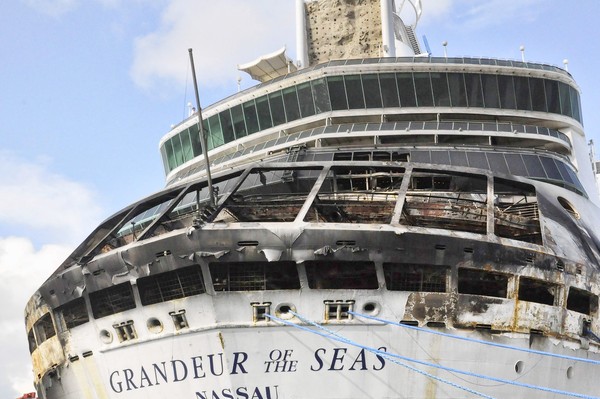
The fire caused so much damage that the rest of the cruise was cancelled and the 2,224 passengers were to be flown from the Bahamas back to Baltimore. Royal Caribbean said on its website that most public areas and staterooms were safe and that power, propulsion and communications systems were not interrupted. The bill of rights for passengers appears that it could not have come at a better time.
The bill of rights includes the following:
The right to disembark a docked ship if essential provisions such as food, water, restroom facilities and access to medical care cannot adequately be provided onboard, subject only to the Master's concern for passenger safety and security and customs and immigration requirements of the port. The right to a full refund for a trip that is canceled due to mechanical failures, or a partial refund for voyages that are terminated early due to those failures.
The right to have available on board ships operating beyond rivers or coastal waters full-time, professional emergency medical attention, as needed until shore-side medical care becomes available.
The right to timely information updates as to any adjustments in the itinerary of the ship in the event of a mechanical failure or emergency, as well as timely updates of the status of efforts to address mechanical failures.
The right to a ship crew that is properly trained in emergency and evacuation procedures.
The right to an emergency power source in the case of a main generator failure.
The right to transportation to the ship's scheduled port of disembarkation or the passenger's home city in the event a cruise is terminated early due to mechanical failures.
The right to lodging if disembarkation and an overnight stay in an unscheduled port are required when a cruise is terminated early due to mechanical failures.
The right to have included on each cruise line's website a toll-free phone line that can be used for questions or information concerning any aspect of shipboard operations.
The right to have this Cruise Line Passenger Bill of Rights published on each line's website.
This incident follows the various incidents plaguing Carnival ships earlier this year that I have blogged about. The Miami Herald has also reported on this latest incident. If you are interested in receiving a copy of the Miami Herald article, you may seek a copy by writing to me at mov@chaloslaw.com.
Comments
Post a Comment